
Getting started
Journal prompts for relationships, said out loud
Journal prompts for relationships with a partner, family or friends, a way to practise a hard conversation out loud, and how to reread one person's entries.
In this guide
- What should you journal about in a relationship?
- What should you journal about with a partner?
- What should you journal about with family?
- What should you journal about with friends?
- What should you journal about when you’re unsure about someone?
- What should you journal about after an argument?
- How do you practise a hard conversation before having it?
- How do you see what keeps happening with one person?
- Can couples journal together?
- Is it safe to journal about someone you live with?
- How do you make it a habit?
- When is journaling not enough?
What should you journal about in a relationship?
Journal about three things: what happened between you, what you felt about it, and what you want from this person. Most entries about a partner, a parent or a friend stall because they only do the first one. They retell the argument and stop there.
Say it out loud for a minute or two. The prompts below are grouped by who the person is, because the questions worth asking about your mum are not the ones worth asking about a new partner. Pick one, answer it, and stop when you’ve said what you actually think.
What should you journal about with a partner?
Journal about what you noticed and didn’t say, what you need and haven’t asked for, and the argument you keep having.
- What did they do this week that I liked and didn’t mention?
- When did I last feel close to them, and what were we doing?
- What do I keep almost saying?
- What do I need from them that I haven’t asked for?
- Which of our arguments is really the same argument?
- What does a good ordinary week look like for us?
What should you journal about with family?
Journal about what you still want from them, who you become around them, and what you would like them to know about your life now.
- What do I still want from this person that I didn’t get as a kid?
- Which version of me shows up when I’m with them?
- What is one thing they do that I now understand differently?
- What do I want our next visit or call to be like?
- What would I like them to know about my life that they don’t?
What should you journal about with friends?
Journal about who you feel like yourself around, which friendships are running on habit, and the message you keep not sending.
- Who do I feel like myself around, and when did I last see them?
- Which friendship am I keeping going on habit alone?
- Who have I been meaning to message, and what’s stopping me?
- What has this friend done for me that I never thanked them for?
- Is there a friendship that ended that I still think about? What happened?
What should you journal about when you’re unsure about someone?
Journal about how you feel after you see them, what you are hoping will change, and what you are giving up to stay.
- How do I feel in the hour after I see them?
- What am I hoping will change, and has anything suggested it will?
- If a friend described this relationship to me, what would I tell them?
- What am I getting from this, and what am I giving up for it?
- What would I be relieved to hear myself say?
What should you journal about after an argument?
Journal about what was actually said, what you were upset about underneath it, and what part of it was yours.
- What was said, and what did I hear? Are those the same?
- What was I actually upset about underneath the thing we argued about?
- What part of it was mine?
- What do I want them to understand that I don’t think they do?
- What would “OK again” look like, in one sentence?
How do you practise a hard conversation before having it?
Say it to your journal first, out loud, in three parts: what happened, what you want them to understand, and what you are asking for. A conversation is spoken, so practise it spoken. You hear where you sound defensive or vague before they do, and the second time through is usually shorter.
Use one prompt from each part:
- What happened. What exactly did they do or say, without the adjectives? When did it start?
- What I want them to understand. How did it land on me? What am I afraid they think I mean?
- What I am asking for. What is the one thing I want to happen next? What would I accept instead?
Then listen back or read it back. If the third part is missing, you are not ready for the conversation yet; you are ready for another entry.
How do you see what keeps happening with one person?
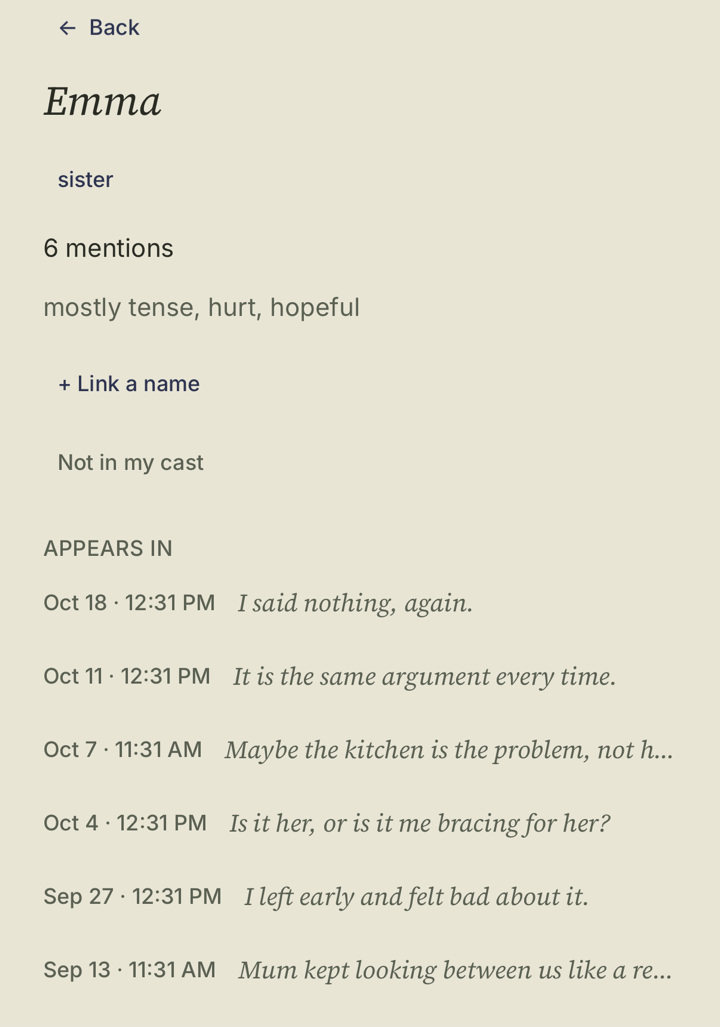
Reread every entry where that one person came up, in one sitting. A single entry about your sister is a bad afternoon. Twelve of them side by side show whether it is always the same topic, always after the same kind of visit, or always on a Sunday.
Ask these five questions while you reread:
- How often does this person come up, and is that more or less than a few months ago?
- What was I feeling in most of these entries?
- What do the bad entries have in common: a place, a topic, a time of week?
- What did I say I would ask for, and did I ask?
- What do the good entries have in common?
This only works if the entries are text you can find. Nobody relistens to three months of audio. Dearly turns your spoken entries into text. The free plan includes 10 transcriptions a day, and every entry is kept as dated text you can scroll back through. Dearly Pro adds your cast: the people, places and topics that keep appearing in your entries, each one with a count. Tap a name to open every entry where that person came up, with dates, so the reread takes a minute instead of an evening.
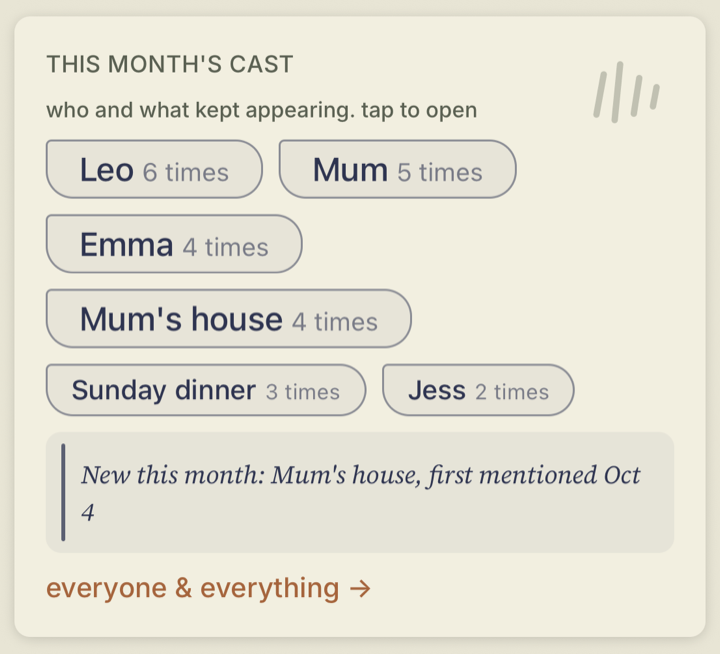
Tap a name and you get that person’s page: how often they come up, the feelings that go with them, and every entry they appear in. In this example, most of the entries about a sister fall on a Sunday.
Keep in mind what your entries are: your side, on the days you chose to talk. They show your patterns with someone, not who that person is.
Can couples journal together?
Yes, if you both want to. Answer the same prompt separately, without hearing each other’s answer, then compare. Answer together and the second person tends to adjust to the first.
Prompts that work as a pair:
- What was the best part of our week?
- What is something I did recently that you appreciated?
- What is one thing on your mind that you haven’t told me?
- Where do you want us to be a year from now?
- What is one small thing I could do this week that would mean a lot to you?
If only one of you wants to do it, keep it as your own journal. Prompts handed to a reluctant partner tend to feel like homework, or a test. The self-reflection questions to answer out loud work just as well for one person.
Is it safe to journal about someone you live with?
It is safer when the journal is locked. A notebook on the bedside table can be opened. That worry is a common reason entries about a partner or family member never get made, or get written so carefully they say nothing. In Dearly, recordings stay on your phone. Audio is sent encrypted only to be transcribed and is never stored. The free plan includes a fingerprint, Face ID or Touch ID lock.
A locked journal also lets you be unfair on the page. A first entry after an argument is often one-sided. That is fine, because nobody else reads it, and the next entry can be fairer.
How do you make it a habit?
Attach a minute of talking to something you already do, such as the walk back after seeing them, the drive home from a family visit, or the few minutes after a call ends. That is when you have the most to say and the details are still fresh.
Not every entry has to be a problem. Saying what went well with someone, even briefly, keeps the record honest when you reread it. The gratitude prompts to say out loud give you a quick way in. If writing is the reason your journals usually stop, how to journal when you hate writing is the place to start.
When is journaling not enough?
Journaling can help you notice what is going on with someone and decide what you want to say. It cannot tell you what the other person feels, and it is not couples counselling. If a relationship involves fear, control or harm, journaling is not the answer: talk to someone you trust, a professional, or a domestic abuse support service where you live.
Dearly is a voice journal for Android and iPhone by BroooApps. Free plan: unlimited recording, 10 transcriptions per day.